


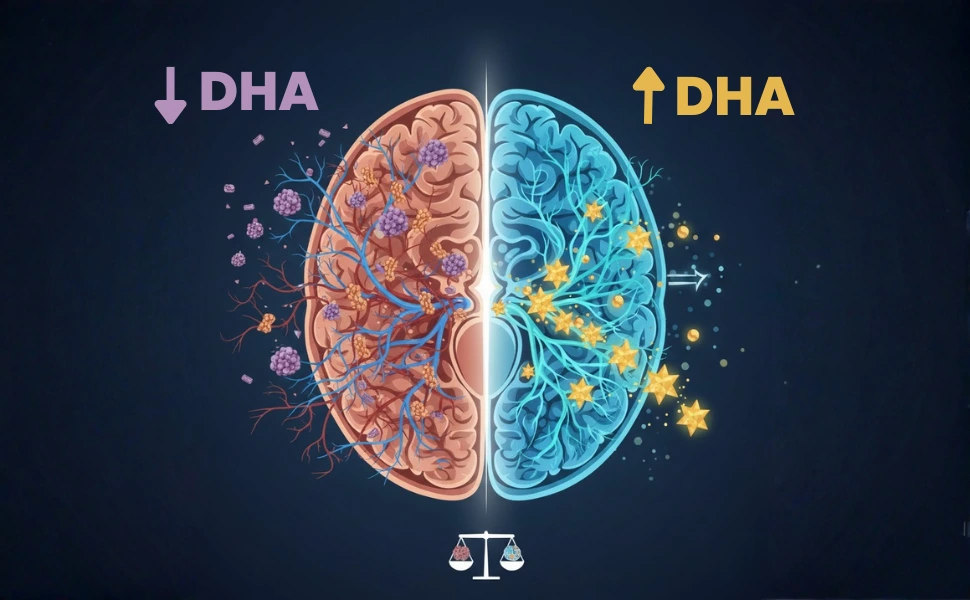

A study in the Journal of Alzheimer’s disease JAD published in 2025 looked at nearly 100 healthy older Japanese adults and found that those with higher blood levels of docosahexaenoic acid, known as DHA, had less deposition of beta-amyloid protein in the brain, a characteristic feature of Alzheimer’s disease. The work was observational and was conducted in people aged 75-89 with good cognitive function, followed for several years.
For these older people, the finding suggests that maintaining adequate and stable levels of DHA over time is associated with less beta-amyloid plaque burden in the brain. This does not imply absolute protection, but it does point to possible room for manoeuvre through nutrition and lifestyle. For any adult looking to the future of their brain health, the central idea is clear – what we do today with our diet can influence how the brain ages tomorrow.
Observational study links DHA in blood with less brain beta-amyloid
The work was conducted as part of the Suita Study, a large population-based study in Japan. The researchers selected 97 adults aged 75-89, all with normal cognitive performance at the time of brain assessment. They measured levels of DHA and another omega-3, eicosapentaenoic acid, or EPA, in blood between 2008 and 2012 and, years later, between 2016 and 2019, assessed beta-amyloid burden in the brain using positron emission tomography, an advanced imaging technique.
The results showed that, in the group of people with beta-amyloid, those with higher levels of DHA in their blood had less beta-amyloid accumulation in the brain. The association held when adjusting for age, sex and a genetic risk variant, APOE4, but lost strength when also considering the presence of cardiometabolic diseases. EPA, on the other hand, did not show a clear association with beta-amyloid deposition.
This is a moderate association, not a dramatic effect, and the observational design does not allow causality to be established. However, the fact that DHA levels were measured several years before the brain imaging reinforces the idea that a nutritional status rich in this omega-3, maintained over time, could influence the physiology of the ageing brain.
DHA as a structural component of the brain and modulator of beta amyloid
DHA is a long-chain omega-3 fatty acid that is particularly concentrated in the membranes of neurons and at synapses, the areas where nerve cells communicate. These membranes are not rigid structures; their fluidity and organisation influence how key proteins, including the beta-amyloid precursor protein, are bundled together. Changes in the fat composition of the membrane can lead to more or fewer beta-amyloid fragments being formed and to their accumulation or more efficient clearance.
In addition, DHA is involved in the formation of molecules called resolvins and protectins, which help to quench inflammatory processes and maintain a more stable brain environment. Chronic low-grade inflammation is associated with increased deposition of beta-amyloid and reduced brain clearance. Therefore, an adequate level of DHA in neuronal membranes may promote a balance in which less toxic beta-amyloid is produced and the amyloid that is generated is better removed.
In the study, blood levels of DHA functioned as a kind of fingerprint of prolonged exposure to this nutrient. People with higher values appeared to have a brain with less beta-amyloid burden in the images. This suggests that, over the years, a diet rich in sources of DHA, such as oily fish, may contribute to a brain environment less prone to accumulating these proteins.
Daily habits that support healthy DHA levels and brain health
The Japanese population studied is characterised by a high consumption of fish, which facilitates high blood levels of omega-3s. In contexts where fish consumption is lower, taking care of the frequency and quality of marine sources becomes even more important. Including small oily fish, such as sardines, mackerel or anchovies, two or three times a week provides DHA and EPA naturally and helps maintain a more brain-friendly fat profile.
Other habits also play a role. Maintaining good control of cardiometabolic factors, such as blood pressure, blood glucose and blood lipids, is associated with better brain vessel health and less low-grade inflammation. The study found that the presence of cardiometabolic disease qualified the strength of the association between DHA and beta-amyloid, reinforcing the idea that omega-3 acts within an overall context of vascular health.
Regular movement, sufficient rest and a diet rich in vegetables, legumes and nuts complete this approach. It is not a single miracle nutrient, but a metabolic environment that helps the brain to age in a more orderly way. In this environment, DHA plays an important role as a structural component and modulator of inflammatory processes and protein deposition.
DHA and phosphatidylserine supplementation as physiological support for brain health
In practice, not everyone is able to maintain a regular intake of good quality oily fish. In these cases, some opt for supplements that provide DHA in concentrated forms and in combination with other nutrients that are also part of the structure and communication of neurons, such as phosphatidylserine. The idea is to provide the body with the same components it uses naturally to build and maintain the brain’s cell membranes.
Phosphatidylserine is a phospholipid found abundantly on the inner surface of neuronal membranes. It is involved in signalling between neurons and in cell renewal processes, and its presence promotes more efficient communication. When DHA from fish oil is combined with phosphatidylserine in the same supplement, it provides a matrix of structural fats that the body recognises and uses in the construction and maintenance of brain membranes.
This type of formulation seeks to respect physiology, not to force it. They are aimed primarily at adults who already take care of their diet, physical activity and rest, and who want additional support focused on brain structure and metabolism. The Japanese study did not evaluate supplements, but it does reinforce the importance of maintaining sustained levels of DHA in the blood, which can be achieved with a combination of a fish-rich diet and, where it makes sense, with the help of well-designed supplements.
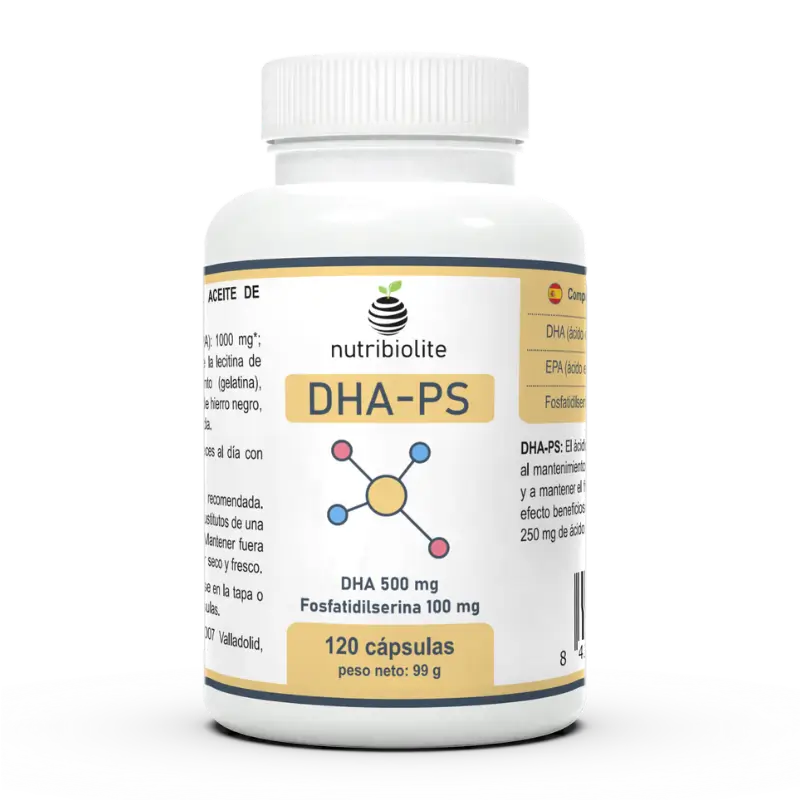
DHA-rich fish oil supplement combined with phosphatidylserine, intended for adults who wish to support their brain’s natural structure and metabolism within a healthy lifestyle.
In summary, long-term DHA care is an investment in brain ageing
The Japanese study suggests that, in healthy older adults, higher blood levels of DHA are associated with less beta-amyloid deposition in the brain. It does not prove a causal relationship or guarantee complete protection, but it fits with decades of research that places marine omega-3s as key players in the structure and balance of the nervous system.
For everyday life, the message is simple, a diet including regular oily fish, good control of cardiometabolic factors and, where appropriate, responsible use of supplements rich in DHA and phosphatidylserine, can be part of a sensible strategy to accompany the brain in the ageing process. This content is for informational purposes only and is not a substitute for the advice of a healthcare professional.
Frequently asked questions
What does it mean that there is an inverse association between DHA and beta-amyloid?
It means that, in this study, people with higher blood levels of DHA showed less deposition of beta-amyloid protein in the brain. It does not imply absolute protection, but it suggests that omega-3 nutritional status may influence how these proteins accumulate with age.
Does this study prove that DHA prevents Alzheimer’s disease?
No, the study is observational and was conducted in older adults with normal cognitive function. It shows a relationship between DHA levels and beta-amyloid burden, but cannot prove that DHA alone prevents the disease. It indicates a possible supportive role within a set of lifestyle factors.
What is the difference between DHA and EPA in brain health?
Both are marine omega-3s, but DHA is particularly concentrated in neuron membranes and synapses. In this study, only DHA was associated with less beta-amyloid deposition, while EPA did not show a clear association. So when thinking about brain health, DHA often takes centre stage.
Is eating fish enough to take care of DHA levels?
For many people, regular consumption of small oily fish two to three times a week can provide relevant amounts of DHA. However, factors such as dietary preferences, availability of fish or individual needs may lead some people to consider DHA-rich supplements for additional support.
How do DHA and phosphatidylserine supplements fit into a healthy routine?
They fit as one tool in an overall approach that includes a balanced diet, physical activity and vascular health care. They provide structural components of the brain, such as DHA and phosphatidylserine, in concentrated forms, and are intended for adults who want to support long-term brain physiology, not as stand-alone solutions.