




There are days when you wake up and your body feels “thicker”, as if your joints are slow to start and your mind needs its own warm-up. It’s frustrating, because you’re going about your normal life, yet you feel that recovery doesn’t come as easily as it used to.
In networks they call it silent inflammation or inflammaging, and beyond the name there is a simple logic: what you eat, how little you move and the lack of sunshine change internal signals that the body uses to regulate inflammation, circulation and even how it manages calcium. Plus, when your day-to-day life is filled with screens and fast food, it’s easy for the body’s “maintenance mode” to fall short.
The interesting thing is that this issue isn’t fixed by a single magic bullet, because the body works in systems that talk to each other. So when you’re looking for realistic support, it makes sense to think about nutrients that work together, at the same time and with a routine that sticks.
When inflammation becomes your background noise
Part of the story starts in the membranes of your cells, which are like the “skin” that decides what goes in, what comes out and how tissue responds to everyday stress. If your diet is short on omega-3 fats, the body tends to make inflammatory messengers more readily, because it uses what it has on hand to build those signals.
Omega-3s, especially EPA and DHA, integrate into these membranes and promote more stable cellular communication, which is one of the reasons it is associated with cardiovascular support and a more balanced inflammatory response. On the other hand, when you spend weeks with little oily fish and excess ultra-processed foods, it is common to feel more stiffness after sitting, or slower recovery after training.
Then another equally modern axis emerges: low sunlight, low vitamin D and less efficient calcium metabolism. Vitamin D3 helps absorb calcium and maintain muscle and immune functions, yet that calcium needs “direction” to go where it needs to go, and that’s where vitamin K2 comes in, which is involved in proteins such as osteocalcin and MGP, related to the proper use of calcium in the body.
The formula that supports heart, bones and mobility
When you understand these pieces, choosing a supplement stops being an impulse and becomes a coherent decision: provide omega-3 to nourish membranes and modulate signals, and add D3 with K2 to support calcium metabolism more judiciously. Omega-3 with vitamins D3 and K2 therefore fits as a daily staple, especially if your real week doesn’t always include enough fish and walks in the sun.
In practice, these are three concrete micro-benefits that many people appreciate when used consistently and with a sensible diet, because the sum of habits always rules:
1) A “looser” joint feeling when starting the day, especially when your routine involves many hours of sitting. 2) Easy support for cardiovascular health from the ground up, taking care of the quality of the fats that make up your tissues. 3) Daily support for bone and muscle function, thanks to the duo of D3 and K2 in an easy-to-support routine.
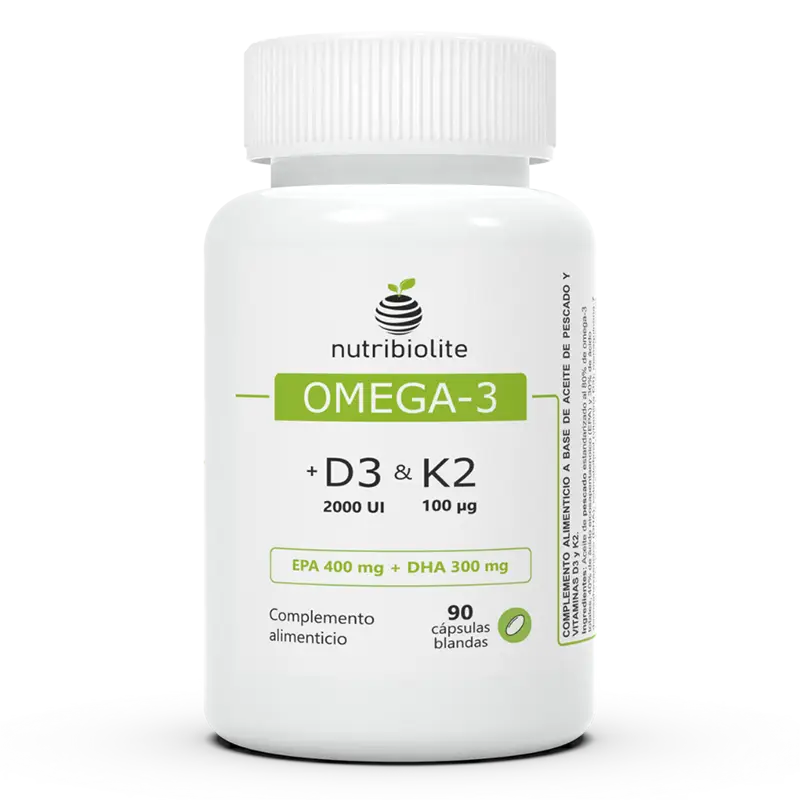
A daily trio to nourish your membranes, support your bones and care for your heart.
If you want to make it even more effective, accompany it with two simple gestures: take it with a main meal and set aside at least 15 minutes of daily walking. Plus, that little combo tends to improve adherence, which in the end is what separates “I tried it” from “I got it in”.
Typical doubts before starting
When is it best to take Omega-3 with vitamins D3 and K2?
It is most practical to take it with a meal that has some healthy fat in it, as this improves the absorption of omega-3 and the fat-soluble vitamins, and also reduces the possibility of digestive discomfort.
I’m afraid of the fishy taste or burping, does it happen?
It does happen to some people, however it is usually minimised if you take it in the middle of a meal and with plenty of water, and it also helps to keep the bottle in a cool place to keep the capsules in good condition.
I am on anticoagulant medication, is it compatible?
If you are taking anticoagulants or anti-platelet medications, or if you are scheduled for surgery, consult a healthcare professional before starting, because omega-3 can affect platelet aggregation and should be personalised.
Why combine D3 and K2 in the same formula?
D3 supports calcium absorption and metabolism, and K2 is involved in proteins that help manage calcium in the body, which is why many people prefer this combination in a single daily routine.
How long does it take to notice anything?
Cell membranes and tissues do not change from one day to the next, so it makes sense to assess sensations and consistency over several weeks, with stable habits and realistic expectations.
A note of caution for your safety
This content is for information only and is not a substitute for medical advice. Food supplements should not be used as a substitute for a balanced diet and healthy lifestyle, and you should not exceed the recommended daily dose; if you are pregnant, breastfeeding, have a medical condition or are taking medication, consult a healthcare professional before use.