


There is a very specific moment when a person starts looking for a cranberry supplement. It’s not out of curiosity. It’s because something has happened, or because something is still happening, and they want to find a practical, convenient and well-formulated solution. The problem is that when they reach the shelf or the results page, all the options look the same. They all say ‘cranberry’. Very few specify how much or what type.
The difference between a supplement that makes sense and one that simply takes up space lies in three specific details. If you know these before you buy, the decision becomes much easier.
Why simply saying ‘cranberry’ isn’t enough
The American cranberry, scientifically known as Vaccinium macrocarpon, contains a special type of molecule called proanthocyanidins (PACs). These PACs, specifically type A, are the focus of most research into urinary wellbeing. The problem is that not all cranberries are Vaccinium macrocarpon. There are other species, such as Vaccinium oxycoccos, which do not have the same PAC profile and do not offer the same effect.
When a label simply states ‘cranberry extract’ without specifying the species or the standardisation percentage, there is no way of knowing how much PACs each capsule actually contains. It could be a lot, or it could be almost nothing. That information matters – a great deal.
The Cochrane review published in 2023, which analysed clinical studies on cranberries and urinary health, identified a daily intake of between 36 and 72 mg of PACs as the benchmark for urinary wellbeing. Many supplements on the market do not reach this figure, or do not allow consumers to know because they do not specify the standardisation.
How PACs work in the urinary tract
Type A proanthocyanidins found in American cranberries have a specific physiological characteristic. Studies suggest that they may hinder the adhesion of infectious bacteria, such as Escherichia coli, to the walls of the urinary tract. They do not eliminate bacteria directly, but rather interfere with the mechanism by which these bacteria attach to tissues and colonise the area.
This effect is dose-dependent. A low or poorly standardised dose is less likely to perform this function consistently. That is why the dose of PACs per capsule is not a secondary consideration; it is the primary criterion of quality.
Hibiscus, for its part, provides polyphenols, including flavonoids and anthocyanins. Various studies attribute complementary properties to it as part of a holistic approach to urinary tract health. It is not a filler. It is a second active ingredient that serves a logical purpose within the formula.
Uritractin: high PACs, hibiscus and no additives
Uritractin is formulated with dry extract of American cranberry (Vaccinium macrocarpon) standardised to 50% PACs. Each capsule provides 125 mg of proanthocyanidins, which clearly exceeds the benchmark identified in the scientific literature. There is no need for calculations or multiplication. The figure is stated on the label because the extract is standardised.
The formula also includes hibiscus flower extract (Hibiscus sabdariffa L.) standardised to 10% polyphenols, ensuring a consistent concentration of bioactive compounds in each capsule. The two ingredients work together; they are not simply added together arbitrarily.
Another aspect that sets it apart from most other products is what it does not contain. It contains no artificial colourings, preservatives or excipients. Instead, the formula uses L-leucine, an essential amino acid, to ensure the stability and quality of each capsule. Suitable for vegans and vegetarians; gluten-free, lactose-free and soya-free.
It comes in a pack of 190 capsules – one per day – which covers more than six months of continuous use. Manufactured in Spain to GMP and HACCP standards.
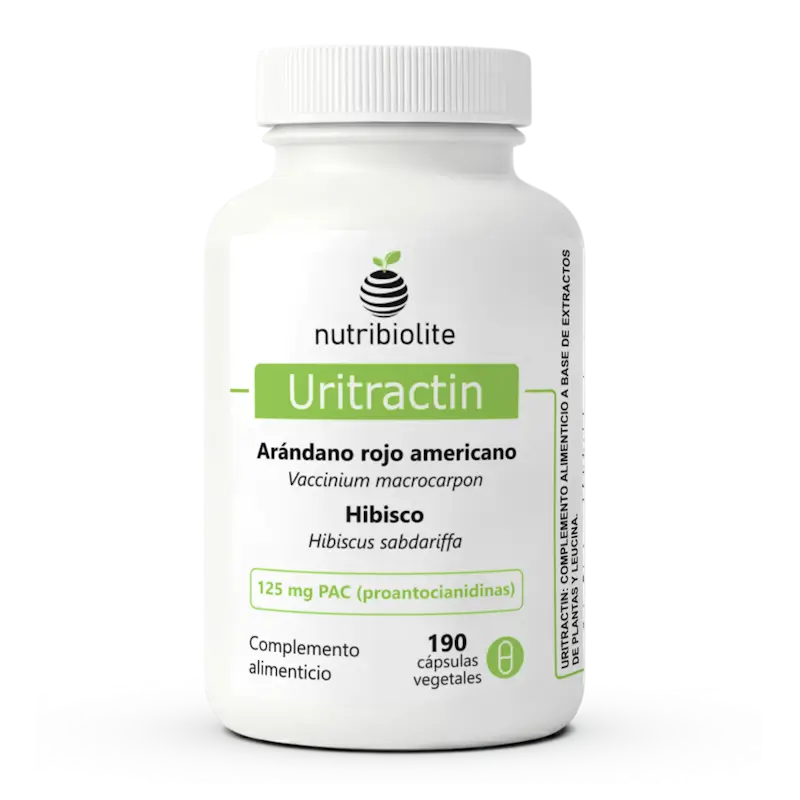
125 mg of American cranberry proanthocyanidins and hibiscus extract in a single daily capsule, with no artificial additives.
Frequently asked questions before buying Uritractin
How many PACs do I need per day for cranberry to be effective?
The 2023 Cochrane review on cranberry and urinary health identified a daily intake of between 36 and 72 mg of proanthocyanidins (PACs) as the benchmark. Uritractin provides 125 mg per capsule, exceeding that threshold with just one daily dose.
Why does it matter that it is American cranberry and not another variety?
Only Vaccinium macrocarpon, the American cranberry, is rich in type A proanthocyanidins, which have been shown to inhibit bacterial adhesion in the urinary tract. Other species, such as Vaccinium oxycoccos, contain mainly type B PACs, which have a different profile and lack the same scientific backing for this use.
What is the purpose of hibiscus in a urinary formula?
Hibiscus extract (Hibiscus sabdariffa L.) provides polyphenols, including flavonoids and anthocyanins, which studies suggest have complementary properties for the urinary tract. In Uritractin, it is standardised to 10% polyphenols, which guarantees a consistent and active concentration in each capsule.
How long do you need to take Uritractin to notice results?
As a dietary supplement, Uritractin is intended for continuous use. The 190-capsule pack, taken once a day, provides more than six months of sustained supplementation. Studies on cranberry assess its effect over periods of regular use, not as a one-off solution.
Is Uritractin suitable for vegans and does it contain any allergens?
Yes, Uritractin is suitable for vegans and vegetarians. It contains no gluten, lactose, soya or other allergens. Nor does it contain any artificial colourings, preservatives or excipients. Instead, it uses L-leucine, an essential amino acid, to ensure the stability of the formula.
This content is for information purposes only and is not a substitute for advice from a healthcare professional. Food supplements should not be used as a substitute for a varied and balanced diet and a healthy lifestyle. If you are taking medication, have a diagnosed medical condition, or are pregnant or breastfeeding, consult a healthcare professional before starting any supplementation.