



If you find yourself optimising your sleep as a project lately, you’re not alone: the “sleepmaxxing” trend has put rest at the centre, and that makes sense because getting a good night’s sleep affects your mood, appetite and mental clarity the next day. The problem comes when you do “everything right” and still go to bed with your head racing or wake up in the middle of the night without knowing why.
It is frustrating to look at the clock, feel the tiredness in your body and yet feel that your brain is still in internal conversation mode. Moreover, when this happens several nights in a row, it is normal that you start to anticipate it and the very attempt to sleep becomes another stimulus that activates the nervous system.
The good news is that, in fact, many of these sensations fit with a fairly consistent biological mechanism: misaligned circadian rhythm, over-present “wake-up” signals at night, and a less than smooth transition to sleep. So rather than adding endless routines, it often works better to support the right signals at the right time.
The mechanism: why the body sometimes doesn’t “enter” into sleep
Your sleep doesn’t just depend on being tired, but on a fine coordination between the internal clock and the level of activation of the nervous system. When bright light falls late, when you have a heavy dinner or when you finish the day with screens and unfinished business, the brain receives contradictory information and delays the night signal, because it interprets that “it is still time to be awake”.
At that point, melatonin, which helps to mark the night, may appear later or with less strength, and that translates into more tossing and turning or a feeling of “light” sleep. At the same time, if you have spent the day under stress or coffee, the body may sustain an elevated sympathetic tone, and even if you go to bed, the physiology is still geared to respond and not release.
This is also where the bridge between calm and rest comes into play: certain messengers associated with well-being and relaxation promote a more stable transition to sleep. However, when the evening comes with too much stimulation, that transition becomes clumsy, and instead a kind of “second wave” of energy appears that many people mistake for being well, but ultimately pay the price the next day.
So the smart approach is often twofold: on the one hand, respect the signals of the biological clock, and on the other hand, support the gradual disconnection to ground the mind and body. Still, intention and willpower are not always enough, especially in times of work, travel or real worries.
The solution: a well-thought-out aid to your night-time routine
When you understand the mechanism, the choice of a supplement ceases to be a “just in case” and becomes a logical decision: to support the night signal and facilitate a calmer landing. 4Sleep combines melatonin with botanical extracts and Griffonia (source of 5-HTP), and that combination fits particularly well when you are looking for regularity and a more “orderly” night-time feeling, as well as a gentler sleep experience.
In practice, these are three concrete micro-benefits that many people value when using 4Sleep with consistency and reasonable sleep hygiene, because the context matters as much as the ingredient:
- It can help you shorten the “gap” between going to bed and finally feeling the body surrender naturally.
- It can promote a more stable night, with fewer long awakenings that leave your mind racing.
- It can contribute to a more predictable night-time routine, which often translates into waking up with a better sense of restfulness.
Moreover, the idea is not to chase a perfect night, but to build a more reliable pattern, even when the day has been intense. That’s why 4Sleep is best understood as part of a day’s closure: warmer lights, simple dinner and a real margin for slowing down, however short.
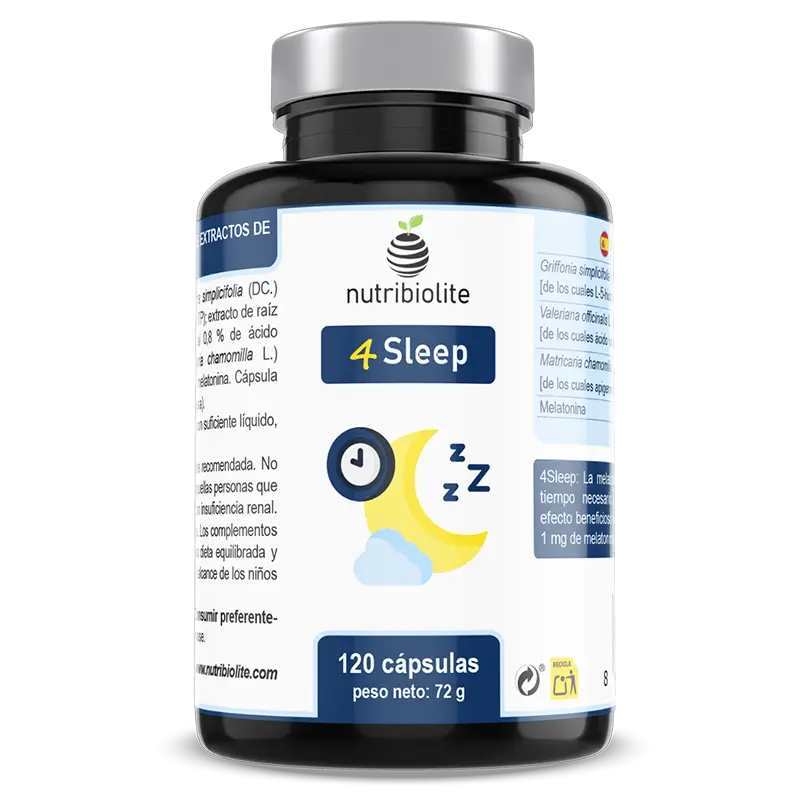
Elegant night-time support for turning on the sleep signal and smoothing the transition to sleep.
FAQs
When should I take 4Sleep to feel better?
In general, it usually makes more sense to integrate it as part of the closing of the day, with a relatively stable bedtime, because the body learns by repetition. Also, if you accompany it with soft lights and screens further away, the night signal becomes clearer and the result is usually more consistent.
I’m worried about “getting used to it” – can it lead to dependency?
This is a common objection, and it makes sense to raise it when something affects rest. Still, the best approach is to use it with intention and routine, because the goal is to support a stable habit, and if you have persistent insomnia it is worth checking with a health professional for underlying causes.
Can it make me groggy in the morning?
Another typical concern has to do with residual sleepiness, especially if you get up early the next morning. However, the experience often depends on individual sensitivity, time of intake and total sleep, so it is best to respect a sufficient window for sleep and not to mix it with habits that fragment the night.
Can I combine it with alcohol, coffee or late dinners?
If you are looking to improve rest, the wisest thing to do is to avoid it competing with factors that disrupt it, because alcohol and large dinners fragment sleep, and late caffeine sustains arousal. Conversely, a light dinner and limiting stimulants from mid-afternoon onwards tends to enhance any night-time strategy.
I am taking medication or have a medical condition, what do I do?
In this case, the responsible thing to do is to check with your doctor or pharmacist first, as there may be interactions or situations where you may need to adjust your approach. In addition, if you are pregnant, breastfeeding or if it is for children, professional advice is even more important.
Health warning
This content is for information only and is not a substitute for medical advice. Food supplements should not be used as a substitute for a balanced diet and healthy lifestyle, and it is important not to exceed the recommended daily dose. If you have medical conditions, take medication, are pregnant or breastfeeding, consult a healthcare professional before use.