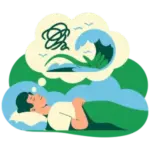




You sit down to work and your mind takes too long to start. You open one tab, then another, reply to a message, come back to the document and find you’ve been orbiting around a simple task for twenty minutes. Many people call it brain rot, a clumsy but fairly accurate way of describing that mental fog that appears when the brain receives too much stimulus and too little cognitive rest.
The frustrating thing is that it’s not always sleep deprivation or lack of motivation. Sometimes you’ve had a reasonably good night’s sleep, yet your concentration is frayed because your attention has been jumping for hours between notifications, small decisions, visual noise and constant pressure to perform. So the problem doesn’t feel like laziness, but like a cluttered brain that is starting to waste energy inefficiently.
In fact, this feeling has a clear biological logic. When mental overload accumulates, the nervous system enters a dynamic of sustained vigilance, working memory suffers and maintaining focus requires more effort than normal. This is where many people reach for coffee after coffee, even though what they need instead is more stable cognitive support and a strategy that does not rely on stimulating themselves by punching themselves.
Why your focus breaks down so easily
Sustained attention depends on several gears working at the same time. The brain needs to efficiently produce energy, filter out distractions, keep certain neurotransmitters active, and allocate resources between memory, mental speed and executive control. When you spend too many hours multitasking, with background stress and continuous context switching, that balance becomes more fragile because every interruption has a real metabolic cost.
Moreover, mental fatigue doesn’t always feel like sleep. It often appears as sluggishness, digital impulsivity, difficulty remembering something that seemed clear a minute ago, or that need to reread the same sentence three times. However, the underlying problem is often similar: the brain is consuming resources to sustain alertness and performance in an environment that disperses more than it allows for depth.
At the same time, certain periods of demand increase the perception of cognitive exhaustion because they increase the stress load and reduce quality retrieval. This affects clarity, immediate memory and a sense of mental control. This is why so many people say that their heads are on but not sharp enough, as if there is activity, even if precision is lacking.
Smart help when your mind wanders
When you understand that pattern, the logical response is no longer to keep pushing with caffeine or willpower. The sensible thing to do is to support the brain where it notices it most – mental clarity, cognitive endurance and sustained performance without relying on an artificial peak. That’s where Minfire fits in, a natural, caffeine-free nootropic designed for those days when you need to think better, not just feel faster.
Its approach is particularly interesting because it accompanies mental work without adding the jitters typical of stimulants. It also fits well when you are looking for three very specific things: to maintain concentration for longer, to notice a more agile working memory in demanding tasks and to reduce that feeling of mental exhaustion that appears before the end of the day. Still, the best reading of the product is practical, a formula created to support focus and performance in a real routine, with screens, pressure and long days.

More stable mental clarity to perform better when the day demands real attention.
In other words, Minfire makes sense when you notice that your head is still active but your focus no longer follows. Because a saturated mind doesn’t always need more stimulation, sometimes it needs better support to function with more clarity, more continuity and less internal friction.
What most people ask before trying it
If there is no caffeine in it, can you really feel it?
Yes, and that’s part of its appeal, because many people are looking for focus without tachycardia, without extra tension and without the crash that often comes after an overly aggressive stimulus.
Does it help if I work long hours with screens?
This is a very common context, because digital fatigue punishes sustained attention and mental clarity. In addition, a caffeine-free aid is often a better fit when the main problem is accumulated cognitive fatigue.
Am I worried about feeling rushed or jittery?
This is a logical objection, especially if you have already tried intense stimulants. In this case the approach is geared towards mental performance without caffeine, so it’s friendlier for those who want focus without overexcitement.
When does it make the most sense to use Minfire?
It tends to work well in times of high intellectual demand, study, analytical work or days where you need to sustain clarity and working memory for hours without taxing the nervous system.
Is the supplement enough if I live scattered all day?
Don’t think of it that way, because context matters. Getting enough sleep, reducing interruptions and creating cleaner blocks of work goes a long way, and also makes any cognitive support strategy make more sense.
A note of caution before we begin
This content is informational and is not a substitute for the assessment of a healthcare professional. Food supplements should not be used as a substitute for a balanced diet and healthy lifestyle, and it is important to adhere to the recommended daily dosage. If you are pregnant, breastfeeding, taking medication or have a medical condition, consult a healthcare professional before use.