




When you’re looking for a supplement for brain health or eye health, the market offers dozens of options. Omega-3 capsules, bottles of phosphatidylserine, cognitive complexes with endless lists of ingredients. And at that point, most people do the same thing: they compare prices, check the number of capsules and hope it works.
There are three criteria that almost nobody checks before buying, and which make the real difference between a supplement that delivers and one that just takes up space in the cupboard. This article explains them, and also shows why Nutribiolite’s DHA-PS meets exactly those three criteria.
The brain and eyesight require two specific nutrients
Docosahexaenoic acid (DHA) is the most abundant omega-3 fatty acid in the human brain. It forms part of the phospholipids in neuronal membranes and is present in high concentrations in the retina. This is no minor detail: without DHA, neuronal membranes lose their fluidity and communication between them becomes less efficient.
Phosphatidylserine is a phospholipid found throughout the body, but it is particularly concentrated in the cerebral cortex. In neurons, it acts as a structural and functional platform, and importantly, up to 30 per cent of the fatty acids that make up this phospholipid can be DHA. The two nutrients work together naturally in the brain, not independently.
The problem is that phosphatidylserine, in powder form, requires a lipid environment to dissolve properly during digestion. When taken on its own, its absorption depends on what you have eaten. When taken alongside DHA in oil, that lipid environment is already guaranteed within the capsule.
Why an isolated supplement isn’t the same
A standard fish oil does provide DHA, yes, but without phosphatidylserine. A phosphatidylserine supplement on its own only provides the phospholipid, but without the lipid environment that optimises its absorption. Combining them separately in different bottles is not the same as having them formulated together in a single capsule.
When DHA and phosphatidylserine are encapsulated together, the oil creates the lipid environment that phosphatidylserine needs to become soluble in the digestive tract. The result is improved bioavailability compared to taking both nutrients separately. This is one of the technical criteria that most clearly distinguishes high-quality combined formulas from generic supplements.
The second criterion is concentration. Not all fish oils provide the same amount of DHA. Many omega-3 products have low concentrations, meaning you need to take three or four capsules a day to reach a meaningful dose. With DHA-PS, each daily dose provides 500 mg of DHA, double the 250 mg recognised by European regulations as the reference intake for the normal maintenance of brain function and vision.
DHA-PS, a formula combining specific ingredients
Nutribiolite’s DHA-PS combines Omegatex® fish oil, containing 50% DHA in the form of triglycerides, with 70% Sharp-PS® Green phosphatidylserine, derived from sunflower lecithin and completely soya-free. These are two ingredients with clear traceability, not generic ingredients of unknown origin.
Omegatex® oil is developed by the Spanish company Solutex® and concentrated using a process free from organic solvents and high temperatures, ensuring purity and a lack of odour. Sharp-PS® Green phosphatidylserine comes from sustainable crops in Europe. Neither ingredient contains soya, gluten, lactose or added sugars.
The product comes in small, easy-to-swallow soft capsules with no fishy taste or smell. The recommended dose is one capsule twice a day with a meal. No dosage complications, no large capsules, no aftertaste.
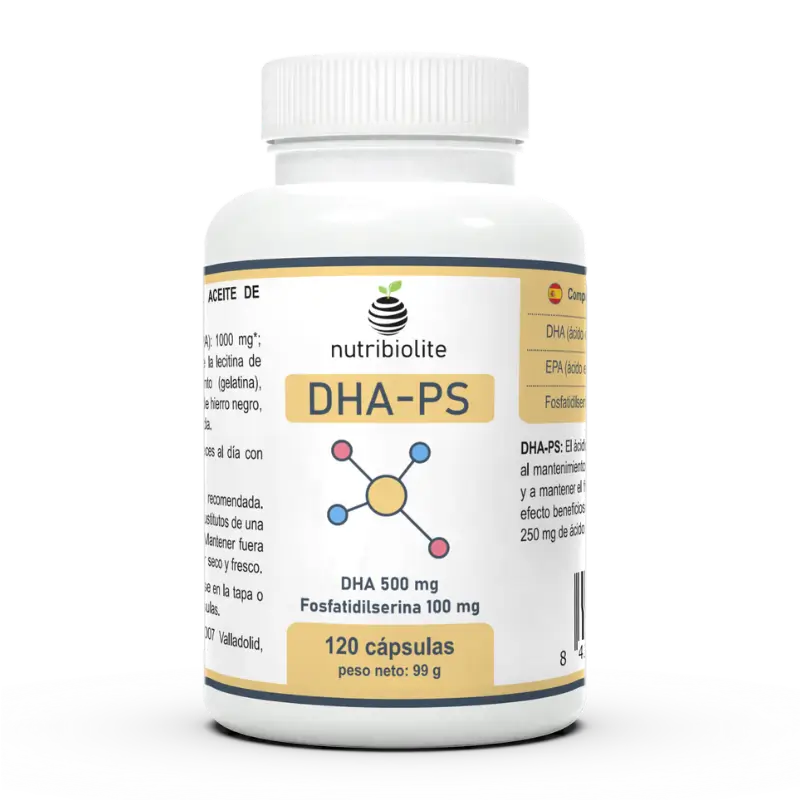
500 mg of DHA and 100 mg of phosphatidylserine in a single capsule, with clearly identified ingredients and a formula that is soya-free, gluten-free and fish-odour-free.
Frequently asked questions before buying DHA-PS
What is the difference between DHA-PS and standard omega-3?
A standard omega-3 supplement provides DHA and EPA, but does not include phosphatidylserine. DHA-PS combines both nutrients in a single capsule, which improves the absorption of phosphatidylserine thanks to the lipid environment created by the fish oil. Furthermore, Omegatex® oil is concentrated to 50% DHA, which is significantly higher than many omega-3 products on the market.
How much DHA does each daily dose of DHA-PS provide?
Each daily dose – two capsules taken with meals – provides 500 mg of DHA. European regulations recognise that 250 mg of DHA per day contributes to the normal maintenance of brain function and vision. DHA-PS provides twice that reference amount.
Is it suitable for people with soya or gluten allergies?
Yes. The phosphatidylserine in DHA-PS is Sharp-PS® Green, derived from sunflower lecithin and completely soya-free. The product contains no gluten, lactose or added sugars. If you have any specific food sensitivities, please check the full list of ingredients or consult a healthcare professional before starting.
Can older people or pregnant women take it?
DHA-PS is suitable for adults of all ages, including older people and pregnant or breastfeeding women. During pregnancy and breastfeeding, the mother’s intake of DHA contributes to the normal development of the brain and eyes of the foetus and infant. In any case, it is recommended that you consult a healthcare professional before starting any supplement during these stages.
Do the capsules smell or taste of fish?
No. Omegatex® oil is concentrated using a process that involves no organic solvents or high temperatures, which eliminates the typical smell and taste of fish oil. The capsules are soft, small and leave no aftertaste, which makes all the difference when taken daily over the long term.
This content is for information purposes only and is not a substitute for advice from a healthcare professional. Food supplements should not be used as a substitute for a varied and balanced diet and a healthy lifestyle. If you are taking medication, have a diagnosed health condition, or are pregnant or breastfeeding, consult a healthcare professional before starting any supplementation.