



Some people already know they want to look after their brain and eyesight with docosahexaenoic acid (DHA) and phosphatidylserine. The problem is that most guides and forums lead to the same question: does it make sense to take them together, or is it better to take them separately? This question has a specific technical answer, and it has real consequences for what you absorb every day.
The answer isn’t just about convenience. It’s about digestive biology. And that difference is precisely what explains why Nutribiolite’s DHA-PS exists as a combined formula, rather than as two separate products in the same order.
What changes when you combine them properly
Phosphatidylserine is a phospholipid with a waxy structure. In its pure powder form, its solubilisation in the digestive tract depends on the availability of a lipid environment. Without that environment, intestinal absorption becomes less efficient. It’s not that it doesn’t work; it’s just that it works less effectively when it reaches the intestine on its own.
DHA, being a fatty acid, is naturally in the form of oil. It creates the lipid environment that phosphatidylserine needs to dissolve and be absorbed. By combining them within the same softgel, the fish oil acts as a natural carrier that facilitates the solubilisation of phosphatidylserine during the digestive process. The result is improved bioavailability compared to taking them at different times or in formats that do not allow for this direct contact.
Why the brain and eyes depend on both
DHA is the most abundant omega-3 fatty acid in the human brain. It forms a structural component of neuronal membranes, particularly in the grey matter, and is present in high concentrations in the retina. Docosahexaenoic acid contributes to the maintenance of normal brain function and normal vision, in accordance with Regulation (EU) No 432/2012, with a beneficial effect from 250 mg per day.
Phosphatidylserine, for its part, is distributed throughout the body, but its concentration is highest in the cerebral cortex. In neuronal membranes, it acts as a structural and functional platform for other key components, including DHA itself, which can account for up to 30 per cent of the fatty acids bound to this phospholipid. These are not simply two ingredients that add up. They are two ingredients that work within the same tissue, on the same membrane, with a genuine biological relationship.
DHA-PS combines the two in a single daily dose
DHA-PS combines Omegatex® fish oil, containing 50% DHA and 10% EPA, with 70% Sharp-PS® Green phosphatidylserine, derived from sunflower lecithin and free from soya. Each daily dose of two capsules provides 500 mg of DHA and 100 mg of phosphatidylserine, in a small soft-gel capsule that is odourless and tasteless, with no fishy smell or taste, and is free from gluten, lactose and added sugars.
Omegatex® oil is developed by the Spanish company Solutex® and concentrated without the use of organic solvents or high temperatures; it is IFOS-certified, guaranteeing purity, freshness and the absence of contaminants such as heavy metals. Sharp-PS® Green phosphatidylserine is sourced from sustainable sunflower crops in Europe; it is soya-free and GMO-free, with high purity and proven bioavailability.
The dosage is simple: one capsule twice a day with sufficient liquid during a meal. The bottle contains 120 capsules, enough for two months of continuous supplementation.
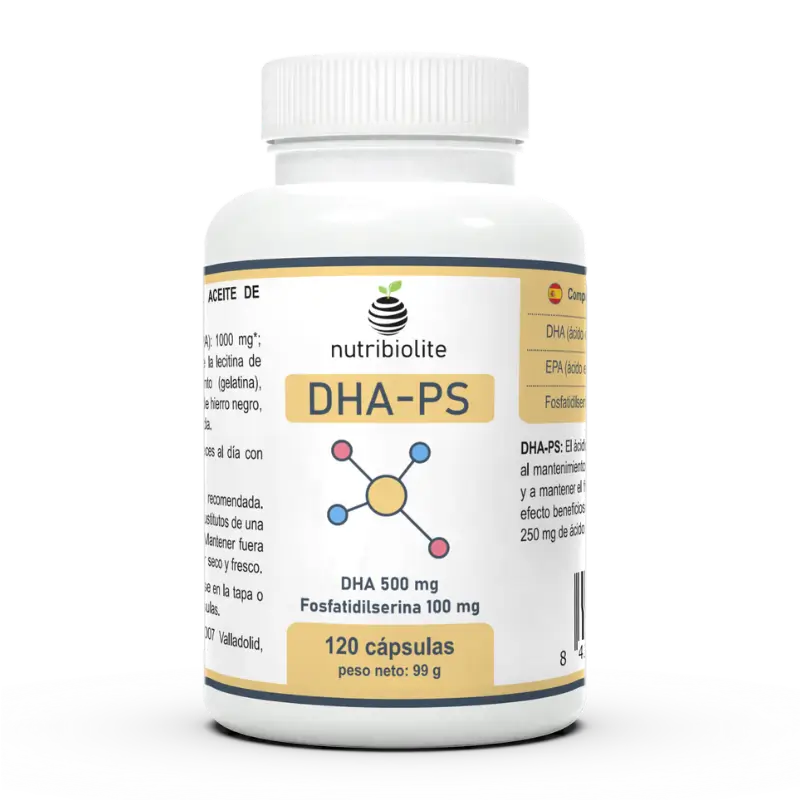
500 mg of DHA and 100 mg of phosphatidylserine per dose, with clearly identified ingredients and free from soya, gluten and fishy odours.
What to consider before buying
What is the difference between taking DHA and phosphatidylserine together or separately?
The main difference lies in absorption. Phosphatidylserine powder requires a lipid environment to dissolve properly in the gut. When combined with fish oil in the same capsule, the DHA naturally creates this environment, improving the bioavailability of phosphatidylserine. Taking them at different times or in different forms does not create this direct contact within the same capsule.
Does the phosphatidylserine in DHA-PS come from soya?
No. DHA-PS uses Sharp-PS® Green phosphatidylserine, sourced from sunflower seeds grown using sustainable farming practices in Europe. It is completely soya-free, making it suitable for people who wish to avoid this allergen or prefer an alternative plant-based source.
How much DHA does DHA-PS provide per daily dose?
Each daily dose, consisting of two capsules, provides 500 mg of DHA. This exceeds the 250 mg per day threshold at which docosahexaenoic acid contributes to the maintenance of normal brain function and vision, in accordance with Regulation (EU) No 432/2012.
Can I take DHA-PS if I am pregnant or breastfeeding?
DHA-PS is suitable for adults of all ages, including pregnant and breastfeeding women. During pregnancy and breastfeeding, the mother’s intake of DHA contributes to the normal development of the brain and eyes of the foetus and the breastfed infant, in accordance with Regulation (EU) No 440/2011. In any case, it is recommended that you consult a healthcare professional before starting any supplementation during these stages.
Do the capsules smell of fish or are they difficult to swallow?
No. DHA-PS capsules are soft, small and have a smooth surface, designed to be easy to swallow. Omegatex® fish oil is concentrated and purified using a process that does not involve organic solvents or high temperatures, which eliminates the characteristic fishy odour. They also contain no artificial flavourings or synthetic additives.
This content is for information purposes only and is not a substitute for advice from a healthcare professional. Food supplements should not be used as a substitute for a varied and balanced diet and a healthy lifestyle. If you are taking medication, have a diagnosed medical condition, or are pregnant or breastfeeding, consult a healthcare professional before starting any supplementation.