




A study in *BMC Nutrition* 2025 analysed 45 clinical trials involving 96,962 adult participants to assess the effect of folic acid on cardiovascular risk. The meta-analysis showed a statistically significant reduction in the risk of stroke (RR = 0.85; 95% CI: 0.76–0.96) and a modest reduction in the overall risk of cardiovascular disease (RR = 0.95; 95% CI: 0.90–0.99). These results position folate as a key co-factor in the management of homocysteine-associated cardiovascular risk.
What does the 2025 meta-analysis on folate and stroke risk in adults reveal?
The study’s strongest effect was observed in the reduction of stroke risk. Folic acid supplementation proved most effective in participants with high plasma homocysteine levels and low baseline folate levels. In groups with homocysteine levels above 4 micromol/L, the reduction in overall cardiovascular risk was statistically significant with low heterogeneity (RR = 0.90; 95% CI: 0.84–0.96).
The study found no significant effects on all-cause mortality, coronary heart disease, peripheral arterial disease or on HDL or LDL levels. The authors conclude that folate plays a specific and distinct role in cardiovascular risk, rather than having a general effect on all cardiac events. This distinction is important for interpreting the data rigorously.
Why homocysteine is a cardiovascular risk marker that can be modulated by vitamins
Homocysteine is a compound derived from the metabolism of methionine. When it accumulates in plasma, it damages the vascular endothelium through endothelial dysfunction, oxidative stress and prothrombotic mechanisms. This process contributes to the development of atherosclerosis and the risk of ischaemic events.
Folate acts as an essential cofactor in the remethylation of homocysteine back to methionine, thereby reducing its plasma concentration. Vitamins B6 and B12 are involved in complementary transsulphuration pathways. The efficacy of this metabolic pathway depends on the vitamins being available in active forms that the body can utilise directly.
Why conventional folic acid has significant metabolic limitations
Folic acid is the synthetic form of folate. To participate in homocysteine metabolism, the body must convert it into L-5-methyltetrahydrofolate (5-MTHF) via several enzymatic steps, including the MTHFR enzyme. Approximately 10–15 per cent of the population of European descent have polymorphisms in the MTHFR gene that reduce this conversion capacity by between 30 per cent and 70 per cent.
In these individuals, supplementation with conventional folic acid may be less effective. The active form, 5-MTHF, does not require this conversion: the body absorbs it directly and incorporates it into the folate cycle without relying on the enzymatic activity of MTHFR. This difference has practical implications for the effectiveness of supplementation.
How Nutribiolite’s Mag-fusion, a dietary supplement containing B vitamins and magnesium, follows the physiological logic of the study
The meta-analysis assessed folic acid supplementation, often combined with vitamins B6 and B12, for homocysteine metabolism. Nutribiolite’s Mag-fusion contains precisely these three B-complex vitamins, formulated in their coenzyme and bioactive forms.
Folate is supplied as calcium L-5-methyltetrahydrofolate (5-MTHF), the active form that the body utilises directly, without the need for conversion by the liver. This offers an advantage over conventional folic acid, particularly for people with variants of the MTHFR gene. Vitamin B6 is included as pyridoxal-5-phosphate (P5P), its functional coenzyme form, which bypasses the activation steps required by standard pyridoxine. Vitamin B12 is supplied as methylcobalamin, the form with the highest bioavailability and the one the body uses directly in the methionine cycle.
These three vitamins work in concert within the remethylation and transsulphuration pathways, the two main mechanisms by which the body regulates homocysteine levels. Mag-fusion also contains 247 mg of pure magnesium citrate, a highly bioavailable organic salt, as distinct from the buffered citrate that many supplements use in combination with poorly absorbed magnesium oxide. Magnesium acts as a cofactor in numerous enzymatic reactions involved in energy metabolism and, together with vitamin D3, plays a role in maintaining healthy bones and muscles. The formula includes 2,000 IU of vitamin D3 as cholecalciferol, the form naturally produced by the body, which has greater bioavailability than vitamin D2. Mag-fusion contains no artificial colourings, preservatives or excipients.
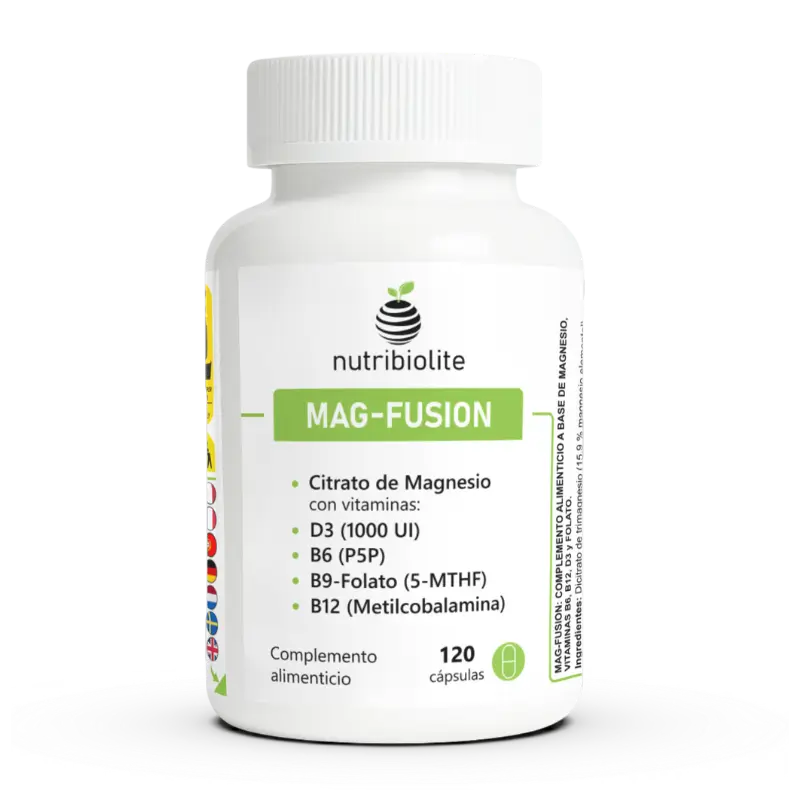
Mag-fusion combines pure magnesium citrate, folate as 5-MTHF, vitamin B6 as P5P, vitamin B12 as methylcobalamin and 2,000 IU of vitamin D3, in bioactive forms without synthetic additives, to support homocysteine metabolism and daily energy balance.
Frequently asked questions about B vitamins, folate and homocysteine
What is homocysteine and why is it important for cardiovascular health?
Homocysteine is a compound produced during the metabolism of methionine, an amino acid found in animal proteins. When plasma levels rise, it can damage the vascular endothelium and contribute to atherogenic processes. Folate, together with vitamins B6 and B12, plays a role in the metabolic pathways that convert homocysteine into harmless or beneficial compounds.
What is the difference between folic acid and folate in the form of 5-MTHF?
Folic acid is the synthetic form of folate. To be utilised by the body, it needs to be converted into 5-MTHF through a series of enzymatic steps that depend on the activity of the MTHFR enzyme. People with common variants of the MTHFR gene have a reduced capacity for this conversion. 5-MTHF is the direct active form: the body incorporates it into the folate cycle without the need for prior conversion.
What did the 2025 BMC Nutrition meta-analysis on folate and stroke show?
The analysis of 45 trials involving 96,962 adult participants showed that folic acid supplementation reduced the risk of stroke by 15% (RR = 0.85; 95% CI: 0.76–0.96). A modest but statistically significant reduction in the overall risk of cardiovascular disease was also observed (RR = 0.95). The effect was more pronounced in people with high homocysteine levels and low baseline folate levels. No significant effects were found on mortality, coronary heart disease or lipid profile.
Why is vitamin B12 in the form of methylcobalamin superior to cyanocobalamin?
Cyanocobalamin is the most common form found in lower-cost supplements. The body must convert it into methylcobalamin before it can be utilised. Methylcobalamin is the active form that functions directly in the methionine cycle and in the nervous system. This conversion may be less efficient in older people, those with atrophic gastritis or those with low intrinsic factor production – common conditions that affect the absorption of vitamin B12.
Why is Mag-fusion’s pure magnesium citrate different from buffered citrate?
Many supplements labelled as magnesium citrate combine this salt with unreacted magnesium oxide, an inorganic form with very low bioavailability. This mixture is known as buffered citrate. Mag-fusion uses only pure, fully reacted magnesium citrate, with no hidden magnesium oxide, ensuring superior absorption and good digestive tolerance. The daily dose of 247 mg of elemental magnesium complies with the maximum limit recommended by the European Commission’s SCF for dissociable salts.
This content is for information purposes only and is not a substitute for advice from a healthcare professional.